What Should I Do About Severe Tooth Pain Right Now?
You're in pain, it's the worst timing imaginable, and you need answers fast. Here are the three questions patients search most, with honest, actionable answers from our dental team.
Before you read further
If you have severe tooth pain with fever, facial swelling, or difficulty swallowing or breathing, stop reading and call us or go to the emergency room now. These are signs of a spreading infection that can become life-threatening.
How do I stop severe tooth pain immediately?
This is the single most searched phrase when a toothache strikes. Here's the honest answer: nothing you do at home will fix the underlying cause, but these steps will get you through the next few hours until you can see us.
Step 1
Take the right OTC painkiller (or combine them)
Ibuprofen (Advil, Motrin) is the best over-the-counter option for most toothaches because it fights both pain and inflammation, the two drivers of a throbbing ache. Take 400 mg with food. For severe pain that doesn't respond to ibuprofen alone, research shows that combining 400 mg of ibuprofen with 1,000 mg of acetaminophen (Tylenol) is more effective than prescription opioids and safer. Do not exceed label dosing.
Step 2
Rinse with warm saltwater
Dissolve half a teaspoon of table salt in 8 oz of warm water. Swish gently for 30 seconds and spit. Salt water is mildly antiseptic, helps reduce inflammation, and can flush out food debris trapped near the painful area. Repeat every few hours.
Cold compress
Ice pack wrapped in cloth, applied to your cheek for 15 minutes on, 15 off. Reduces swelling and numbs nerve signals.
Clove oil (eugenol)
Dab a tiny amount on a cotton ball and press it gently against the tooth. Eugenol is a natural numbing agent used by dentists.
OTC numbing gel
Products like Orajel contain benzocaine for short-term surface numbing. Apply directly to the gum near the painful tooth.
Elevate your head
Lying flat increases blood pressure to the head, worsening throbbing. Sleep propped up on extra pillows to reduce pressure.
Things that make tooth pain worse
- Putting aspirin directly on the gum, this causes chemical burns, not relief
- Hot foods and drinks, heat expands inflamed tissue and intensifies nerve pain
- Very cold or very sweet foods if you have a cracked or exposed nerve
- Ignoring the pain and hoping it goes away, most toothaches worsen without treatment
The bottom line
Home remedies are a bridge, not a bridge replacement. They buy you comfort for a few hours. The cause, whether a cavity, cracked tooth, abscess, or failed filling, will not resolve on its own and needs professional treatment.
What causes sudden, unbearable tooth pain?
Understanding the cause helps you describe it accurately when you call our office and helps us triage how urgently you need to be seen.
01
Dental abscess (infected tooth). This is the most common cause of sudden, severe, throbbing pain. Bacteria reach the pulp inside the tooth, causing a pocket of infection. The pain is often constant, may radiate to your jaw or ear, and can be accompanied by swelling, fever, and a bad taste. An abscess will not heal without a dentist, it requires drainage and antibiotics, and sometimes a root canal.
02
Cracked or fractured tooth. A crack exposes the inner dentin and nerve. You may feel sharp, stabbing pain when you bite down or release, a distinctive symptom of a cracked tooth. Cracks are invisible on X-rays and difficult to find without a clinical exam.
03
Advanced tooth decay (deep cavity). When a cavity reaches the pulp, the nerve becomes inflamed, a condition called pulpitis. This causes intense, spontaneous pain that can wake you from sleep. A filling won't fix this; a root canal or extraction is usually required.
04
Failed or lost filling/crown. When a restoration falls out or cracks, it exposes the tooth's inner layers to temperature, pressure, and bacteria, causing rapid-onset pain. Call us we can often see you the same day for this.
05
Gum disease or gum abscess. Severe gum infections can cause bone loss and intense pain that's sometimes mistaken for a toothache. The gums may bleed, swell, and have a foul taste or smell.
06
Impacted wisdom teeth. When a wisdom tooth is stuck beneath the gum and pressing against neighboring teeth, it causes radiating pain along the jaw and can become infected (pericoronitis).
Pain that seems to come from a tooth but doesn't
Sinus infections, ear infections, TMJ (jaw joint) problems, and even heart conditions can all cause referred pain that feels exactly like a toothache. That's another reason a clinical examination matters, only a trained eye can rule out these causes and identify the real source.
When is tooth pain a dental emergency?
Not every toothache needs a same-day visit, but some absolutely do. Here's how to tell the difference.
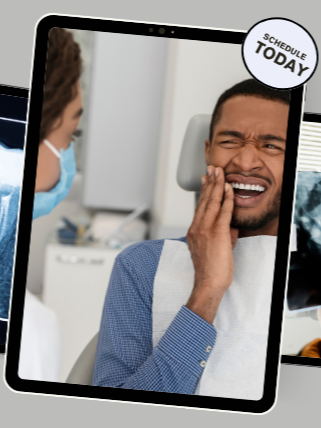
Call us or go to the ER immediately if you have:
- Swelling in your face, jaw, or neck, especially below the eye or forming a visible knot
- Fever (above 101°F / 38.3°C) with tooth pain, your body is fighting an infection
- Difficulty swallowing or breathing, this is a medical emergency requiring the ER, not just a dentist
- Unbearable pain that doesn't respond to any OTC medication
- Visible pus or a pimple like bump on the gums near a painful tooth
- A knocked-out tooth, time is critical; reimplantation works best within 30–60 minutes
- Bleeding that won't stop after applying steady pressure for 15 minutes
Call us for a same-day or next-day appointment if you have:
- Severe, throbbing pain lasting more than 24–48 hours that disrupts sleep
- Sharp pain when biting or releasing bite pressure (sign of a cracked tooth)
- A lost filling, crown, or broken tooth with exposed sensitivity
- Persistent sensitivity to hot or cold that lingers more than 10–15 seconds after the temperature source is removed
- A bad taste in your mouth or foul smell that won't go away, possible sign of infection
A simple test
Ask yourself: "Can I sleep through this?" If the answer is no, it's time to call. Pain that keeps you awake is your body telling you something is wrong that won't wait until your next scheduled cleaning.
What happens when you call us for a dental emergency
We listen first, where it hurts, what triggers it, how long it's been building. Then we examine the area, test sensitivity, take targeted X-rays to find the hidden source, and get you comfortable before laying out a clear treatment plan. Our goal isn't just to chase the pain, it's to find the cause and fix it.
Ready to transform your smile on your schedule?
Book an after-hours appointment today. Emergency slots and cosmetic consultations available evenings & weekends.
© 2026 Dali Dental Studio · All Rights Reserved Miramar, FL · 954-367-9625


