Single tooth implant vs three-unit bridge: what's the real difference?
If you've lost a tooth and you're researching your options in Miramar or the surrounding area, you've likely come across both of these solutions. Both replace one missing tooth. But the way each one works mechanically, biologically, and over time is entirely different. Understanding both gives you the clarity to make a confident choice.
The short answer
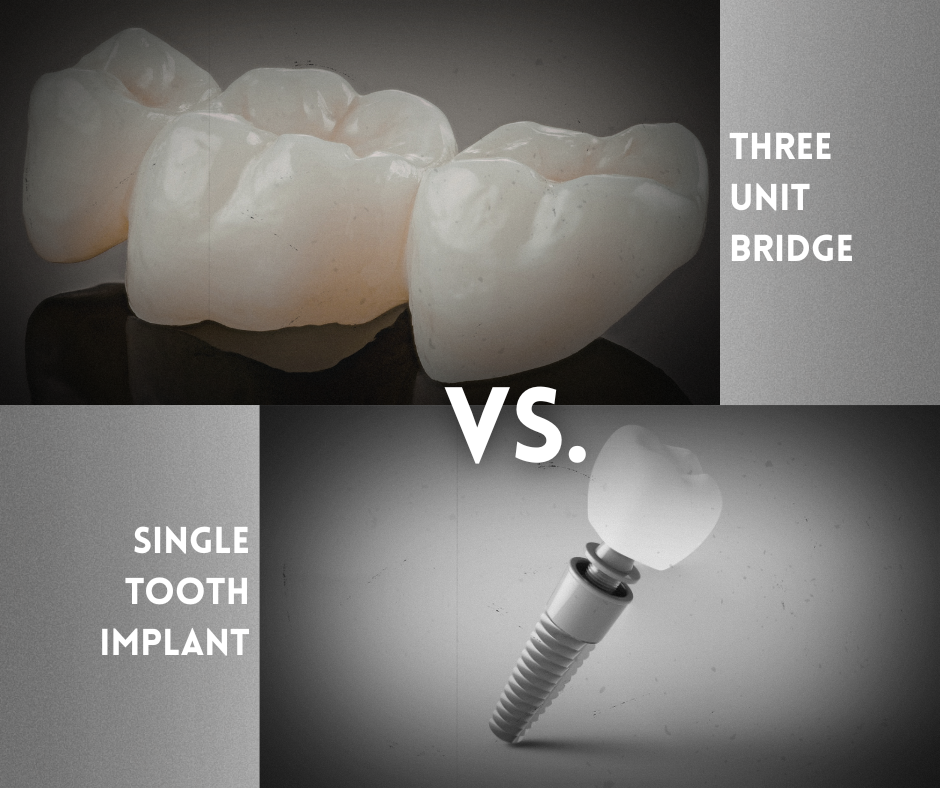
A single tooth implant replaces the root and the crown. It stands completely on its own, independent of the teeth beside it. A three unit bridge spans the gap by anchoring to the two neighboring teeth, which are reshaped to support a fused three crown unit.
Same outcome on the surface a tooth shaped restoration where your missing tooth used to be. Completely different engineering underneath.
Option 1
Single tooth implant
- A titanium post is placed into the jawbone where the root used to be
- Bone heals and fuses around the post osseointegration (3–4 months)
- A custom crown is attached to the top of the post
- Stands fully independent no contact with adjacent teeth
Option 2
Three unit bridge
- Two healthy teeth on either side of the gap are reshaped and reduced
- A digital scan is taken; a three tooth unit is precision crafted
- The middle "pontic" floats above the gum where the tooth was
- The two outer crowns bond to your natural teeth as anchors
Our Miramar dental studio is built around a conservative philosophy. Before recommending any treatment, we weigh what each option asks of your healthy tooth structure — that's the foundation of minimally invasive dentistry.
How they compare across the things that matter most
| Factor | Sigle Tooth Implant | Three Unit Bridge |
|---|---|---|
| Healthy teeth involved | None — fully independent | Two teeth reshaped permanently |
| Timeline | 3–6 months total | 2–3 visits over 2–3 weeks |
| Bone preservation | Stimulates bone, prevents resorption | No root stimulus; bone may recede |
| Long-term durability | Can last a lifetime | Typically 10–15+ years |
| Cleaning | Brush and floss normally | Requires floss threaders under pontic |
| Initial cost | Higher upfront investment | Lower initial cost |
| Surgical component | Minor surgical placement | No surgery, preparation only |
The
healing difference
With an implant, healing is the treatment. The titanium post must fully integrate with your jawbone before a crown can be placed — typically three to four months. This process is passive; you're not in the chair during that time, and the wait is what protects the long-term outcome.
A bridge moves faster. Once the neighboring teeth are prepared and the scan is taken, your permanent bridge is usually placed within a few weeks. There's no osseointegration period. If your timeline matters, that's a meaningful difference.
The long-term outcome difference
An implant behaves like a natural tooth root. It stimulates the jawbone with every bite, which prevents the bone loss that naturally follows tooth extraction. Over years and decades, that matters — both structurally and cosmetically.
A bridge does not replace the root. The bone beneath the pontic receives no stimulation and can gradually resorb over time. The bridge itself may eventually need replacement, and the anchor teeth — which were permanently modified — carry the load of three teeth.
Neither outcome is a failure. They're simply different long-term profiles, and the right choice depends on your specific anatomy, the health of the neighboring teeth, and what matters most to you.
Our modern dental studio in Miramar uses digital scanning and 3D imaging so every consultation is grounded in your actual anatomy, not a generalized estimate. We believe a true luxury dental experience starts with honest, unhurried information. We never recommend more than what's necessary.
So which one is right for you?
If the neighboring teeth are healthy and untouched, most patients benefit from leaving them that way. The implant asks nothing of those teeth and preserving healthy structure is at the heart of our conservative approach.
If the neighboring teeth already have crowns, large fillings, or existing damage, a bridge may address multiple issues in one treatment. If surgery isn't right for you medically, or if you need a faster result, a bridge is a proven and excellent option.
There is no universal right answer. There is a right answer for your teeth, your timeline, and your goals — and that's exactly what we work through together during your consultation at our Miramar office.

Ready to transform your smile on your schedule?
Book an after-hours appointment today. Emergency slots and cosmetic consultations available evenings & weekends.
© 2026 Dali Dental Studio · All Rights Reserved Miramar, FL · 954-367-9625


